
Skip to content

Buying guide

Visual Schedules for Autism

A visual schedule shows what is happening, in order, with pictures instead of only words. Many autistic children, and plenty of others, find a day easier to follow when they can see it. This guide covers how to start, what to include and how to avoid the common pitfalls, then shows the kit we make.

By the Buy Activity Books team · Updated · 4 min read

The short answer

A visual schedule is a row of pictures showing the steps of a routine or a day in order. Start with a simple First / Then board, move to short routines of four to six pictures, and move each card to an All done spot when the step is finished. Our printable kit has boards, routine strips and 48 picture cards.

Key takeaways

  • Start with First / Then before a whole-day schedule.
  • Keep routines to four to six pictures at first.
  • Move finished cards to All done so the child sees what is left.
  • Model it for a while; do not expect solo use straight away.

Our pack for visual schedule for autism

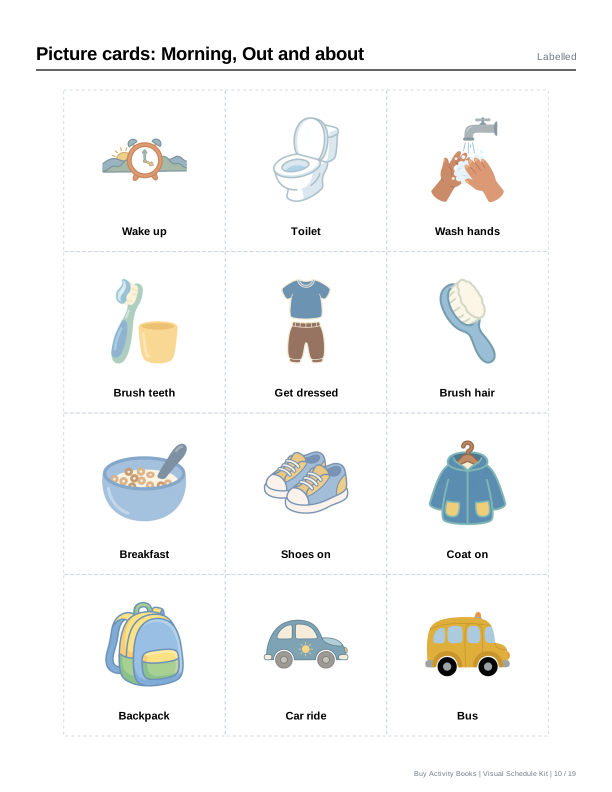
A sample page from Visual Schedule Kit
Boards and 48 cardsAutistic children and early learners

Visual Schedule Kit

Everything to start using visual supports at home or school: a First / Then board, a Now / Next / Then board, morning, after-school and bedtime routine strips, an 8-step daily schedule, an All done box and 48 picture cards in labelled and unlabelled sets, plus word and blank cards.

  • First / Then and Now / Next / Then boards
  • Morning, after-school, bedtime and 8-step daily schedule strips
  • 48 picture cards, labelled and unlabelled, plus word and blank cards
  • Clear line icons with one card per routine step
See inside →

At a glance

Visual Schedule Kit
Best forChildren who use visual supports
Pages19
IncludesBoards, routines, 48 picture cards
SizesUS Letter and A4
Price$6.99

What a visual schedule is

A visual schedule uses objects, photos, drawings or words to show the steps of an activity or a day in order. Visual supports are widely used in autism education, and a 2023 review of the research counts them as an evidence-based practice for autistic children and young people.

That does not mean any one schedule will suit every child. The best schedule is the one that matches the child's way of understanding: objects for some, photos or line pictures for others, written lists for readers.

Step 1: First / Then

First / Then is the simplest visual schedule: two pictures, one task and what comes after it. Put the less preferred activity under First and something the child enjoys under Then. Use it the same way every time for a week or two before adding more.

  • First: shoes on. Then: park.
  • First: brush teeth. Then: story time.
  • First: homework. Then: screen time.

Step 2: short routines

Once First / Then feels familiar, try a routine of four to six steps, such as getting ready in the morning or going to bed. Our kit has strips for morning, after school and bedtime, each with six card spaces and a Done box for every step.

Step 3: the whole day

A full-day schedule can be helpful, but it is a lot of pictures to take in. Build up to it gradually, and consider showing only part of the day at a time, covering later steps if the child rushes ahead.

Using All done

  1. When a step is finished, take its card off the schedule.
  2. Put it in the All done box or on the All done page.
  3. Point to what is left, or to what comes next.
  4. At the end, celebrate that everything is done.

Labelled or unlabelled cards?

Labelled cards pair each picture with its word, which helps children who are starting to read. Unlabelled cards suit children who find extra words distracting. Our kit includes both sets of all 48 cards, plus word cards such as First, Then, Now, Next and Change of plan.

Making cards last

  • Print on card stock if your printer can take it.
  • Cut along the dashed lines and laminate.
  • Use reusable sticky tabs or hook-and-loop dots to attach cards to the boards.
  • Keep spare copies: printable means you can print a lost card again.

When it is not working

  • The child ignores it: keep modelling, pointing to each card as you do the step.
  • The child rushes ahead: cover later steps and show one or two at a time.
  • Change upsets the child: use the Change of plan card to show the swap before it happens.
  • Pictures are not clear to the child: try photos of real objects alongside the cards.

What is in the kit

Everything prints on ordinary paper or card, in US Letter and A4.

  • Boards to start simply

    First / Then and Now / Next / Then boards, plus routine strips with a Done box for each step.

  • 48 picture cards

    Everyday routines from wake up to bedtime, in labelled and unlabelled sets.

  • Word and blank cards

    First, Then, Now, Next, Later, Break, Change of plan and All done, plus blanks to draw your own.

  • Clear, consistent pictures

    Simple line icons in one style, one picture per card, with dashed lines to cut along.

Questions about visual schedule for autism

What age is a visual schedule for?+

Any age. Visual schedules are used with toddlers, school children, teenagers and adults. Pick the pictures and the number of steps to suit the person.

Is this a therapy?+

No. It is a printable set of boards and picture cards, the kind of visual support families and schools use every day. A child's teacher, speech therapist or occupational therapist can help tailor it.

Which 48 pictures are included?+

Everyday routines across morning, out and about, school and learning, food and drink, play and calm, and evening and care: from wake up and brush teeth to school, snack, quiet time, bath and bedtime.

How fast do I get it?+

Straight away. The download page opens as soon as payment goes through, and a link is emailed to you as well, so there is no shipping and no wait.

How do I print the pack?+

After checkout you download a PDF in both A4 and US Letter. Print it on any home, office or school printer, single or double sided. Ordinary printer paper works well for pencil.

Can I print copies for my family or class?+

Yes. For personal and classroom use: print as many copies as your household or class needs. You may not resell the files or the printed pages.

Related guides

All buying guides

Visual Schedule for Autism: Printable Boards and Cards