Skip to content

Buying guide

The Calm Puzzle Ladder: Five Steps for Autistic Kids

Families often ask for puzzles by autism level. The trouble is that support levels describe daily support needs, not puzzle skill, and there are only three of them. So we built a ladder of five puzzle steps instead, based on what a child can do on the page. Every step uses the same calm layout; only the puzzle grows.

By the Buy Activity Books team · Updated · 4 min read

The short answer

The Calm Puzzle Ladder has five skill steps. Step 1 starts with 2 by 2 mazes and three-word word searches; Step 5 reaches 14 by 14 mazes and real 9 by 9 sudoku. Every page has the same layout, a page count and an I finished! box. Start where the child succeeds easily, and move up when puzzles feel quick.

Key takeaways

  • Five steps of puzzle skill, not five autism levels.
  • Every step uses the same calm page: only the puzzle grows.
  • Start one step below where you think the child is.
  • Move up when three puzzles in a row feel easy.

Our picks for autism puzzle levels

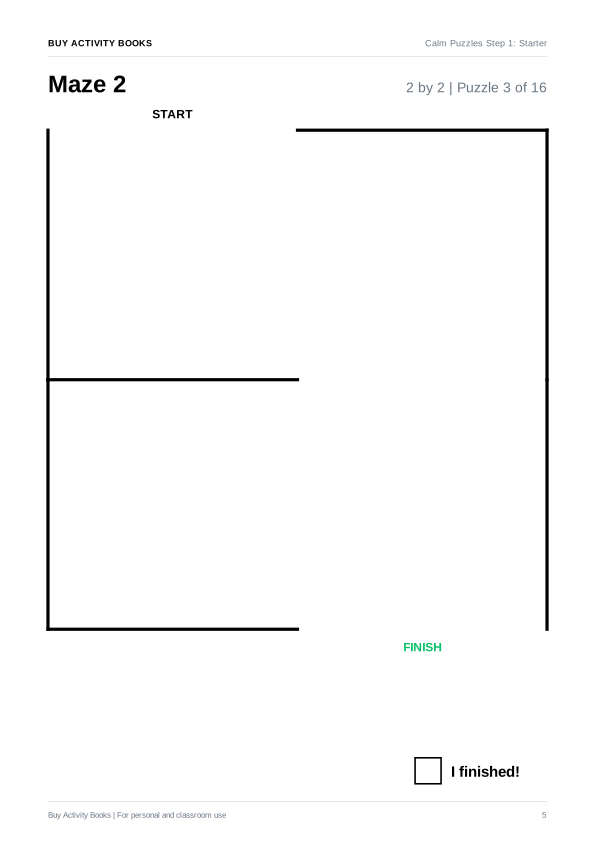
A sample page from Calm Puzzles Step 1: Starter
1Step 1Very first puzzles, any age

Calm Puzzles Step 1: Starter

The very first rung: sixteen puzzles that can each be finished in moments. Mazes from 2 by 2 with paths wide enough for a finger, and 5 by 5 word searches with three short words that only run across. Made for shared puzzle time with an adult alongside.

  • 8 tiny mazes (2 by 2 to 4 by 4) and 8 three-word word searches
  • Paths wide enough to trace with a finger
  • Words run across only: left to right, like reading
  • Same layout, Puzzle 3 of 16 and an I finished! box on every page
See inside →
A sample page from Calm Puzzles Step 2: First Steps
2Step 2Early puzzlers, any age

Calm Puzzles Step 2: First Steps

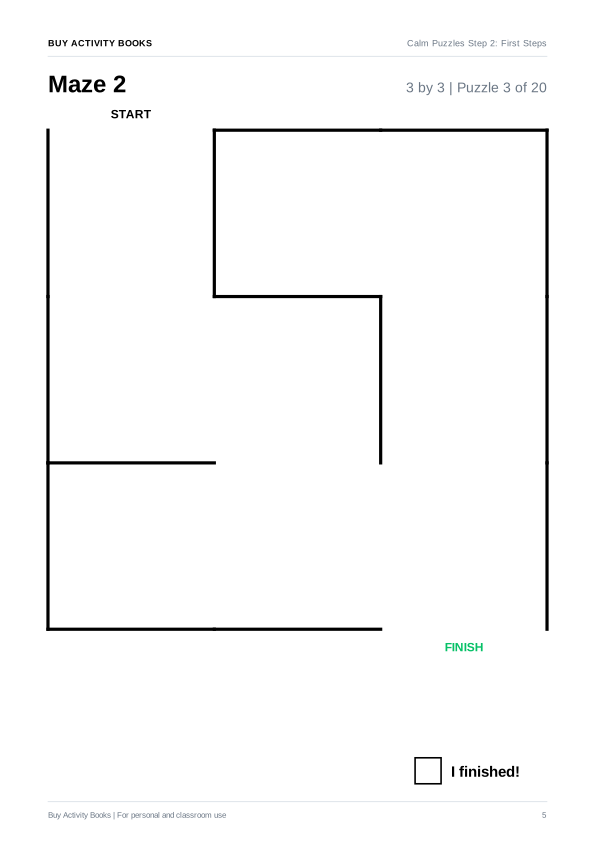
Twenty very simple, very predictable puzzles. Tiny mazes from 3 by 3 with extra-wide paths, and 6 by 6 word searches with four words that only run across or down. Every page has the same layout, a page count and an I finished! box.

  • 10 tiny mazes (3 by 3 to 6 by 6) and 10 four-word word searches
  • Same layout on every page, no pictures or clutter
  • Words run across or down only, never diagonal or backwards
  • Puzzle 3 of 20 on every page, and an I finished! tick box
See inside →
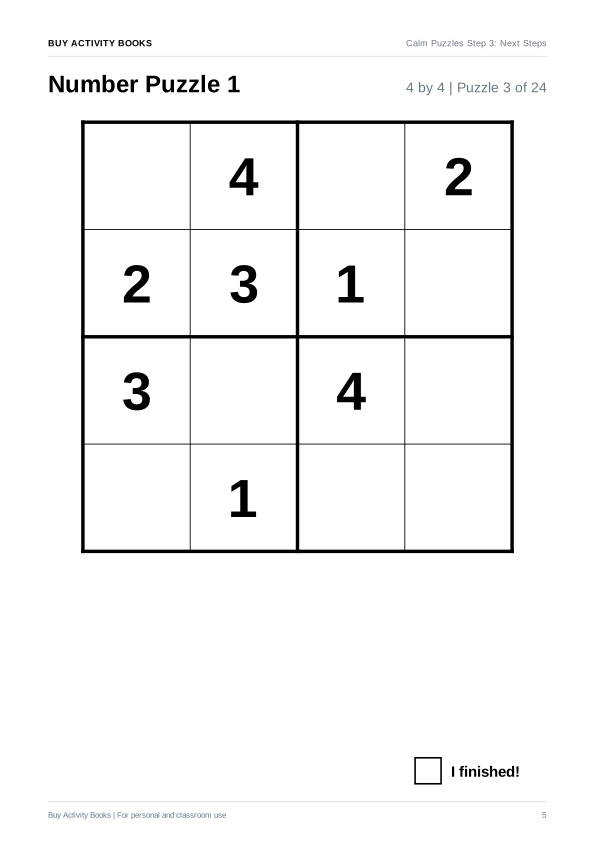
A sample page from Calm Puzzles Step 3: Next Steps
3Step 3Growing puzzlers, any age

Calm Puzzles Step 3: Next Steps

The next calm step: mazes from 5 by 5 to 9 by 9, 8 by 8 word searches with six words, and 4 by 4 number puzzles that introduce sudoku logic with only the numbers 1 to 4. The same predictable layout on every page.

  • 8 mazes, 8 word searches and 8 mini number puzzles
  • 4 by 4 number puzzles: sudoku logic with just 1 to 4
  • Every number puzzle checked to have exactly one answer
  • Same layout, page count and I finished! box on every page
See inside →
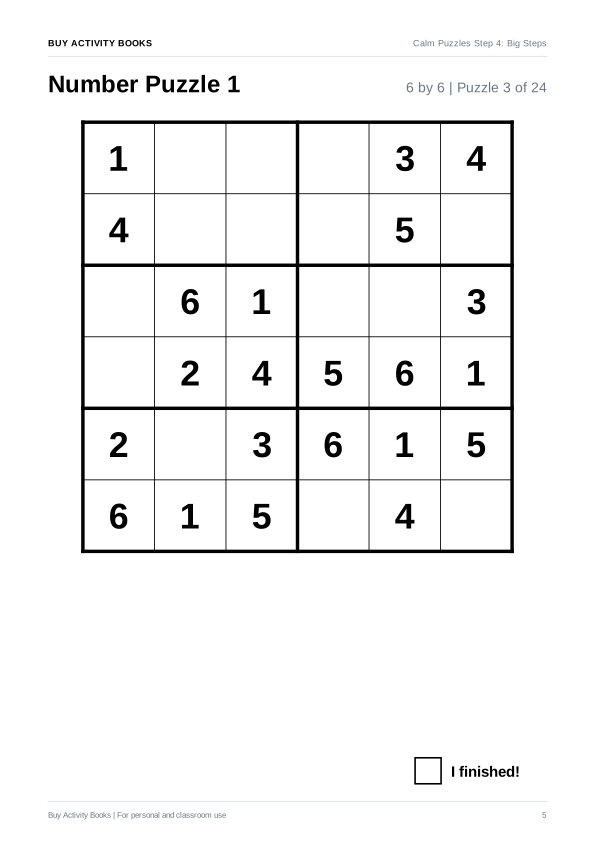
A sample page from Calm Puzzles Step 4: Big Steps
4Step 4Confident puzzlers, any age

Calm Puzzles Step 4: Big Steps

Bigger puzzles on the same calm page: mazes from 8 by 8 to 12 by 12, 9 by 9 word searches with eight longer words on favourite topics like trains, space and dinosaurs, and 6 by 6 number puzzles. Still one task per page, still a clear finish.

  • 8 mazes, 8 word searches and 8 six-by-six number puzzles
  • Interest themes: trains, space, dinosaurs, ocean, vehicles, numbers
  • Every number puzzle checked to have exactly one answer
  • Same layout, page count and I finished! box on every page
See inside →
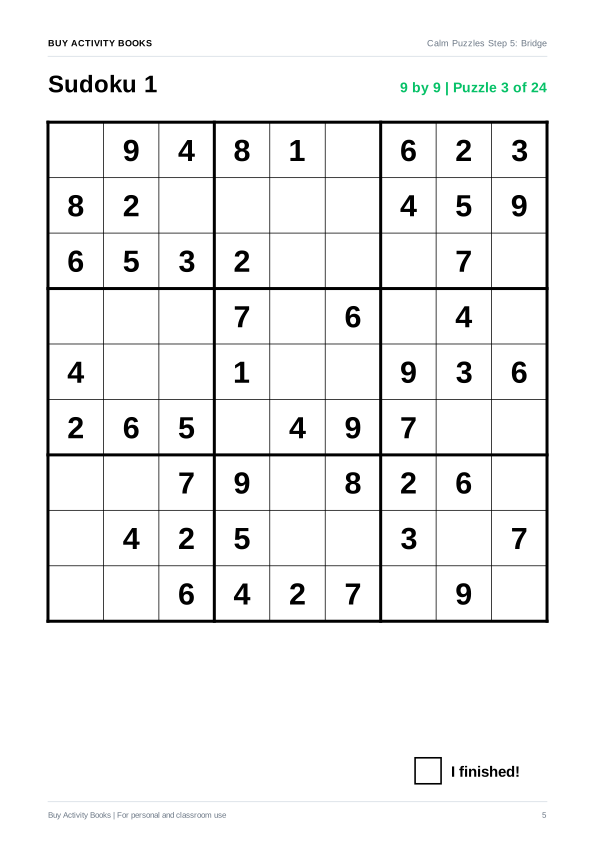
A sample page from Calm Puzzles Step 5: Bridge
5Step 5Ready for standard puzzles, any age

Calm Puzzles Step 5: Bridge

The bridge to standard puzzle books: full-size mazes up to 14 by 14, 10 by 10 word searches with ten words, and real 9 by 9 sudoku with extra numbers given (46 down to 38). The calm page stays the same, so only the puzzle grows.

  • 8 mazes, 8 word searches and 8 full 9 by 9 sudoku
  • Sudoku start with 46 numbers given: gentler than our Beginner level
  • Every sudoku checked to have exactly one solution
  • Same layout, page count and I finished! box on every page
See inside →

Side by side

Step 1: StarterStep 2: First StepsStep 3: Next StepsStep 4: Big StepsStep 5: Bridge
Best forLadder step 1Ladder step 2Ladder step 3Ladder step 4Ladder step 5
Puzzles1620242424
GridMazes 2 to 4, 5 by 5 word searchMazes 3 to 6, 6 by 6 word searchMazes 5 to 9, 8 by 8 word search, 4 by 4 number puzzlesMazes 8 to 12, 9 by 9 word search, 6 by 6 number puzzlesMazes 10 to 14, 10 by 10 word search, 9 by 9 sudoku
DifficultyThree words, across onlyAcross and down onlyAdds diagonal words and 4 by 4 logicLonger words, 6 by 6 logicFull-size puzzles, calm layout
Pages (A4)2227323232
Answer keyYesYesYesYesYes
Paper sizesA4 and US LetterA4 and US LetterA4 and US LetterA4 and US LetterA4 and US Letter
Price$3.99$4.99$4.99$4.99$4.99

The five steps at a glance

StepMazesWord searchLogic
1 Starter2 by 2 to 4 by 45 by 5, 3 words, across onlyNone
2 First Steps3 by 3 to 6 by 66 by 6, 4 words, across and downNone
3 Next Steps5 by 5 to 9 by 98 by 8, 6 words, adds diagonal4 by 4 number puzzles
4 Big Steps8 by 8 to 12 by 129 by 9, 8 longer words6 by 6 number puzzles
5 Bridge10 by 10 to 14 by 1410 by 10, 10 words9 by 9 sudoku, 46 to 38 given

Steps are not autism levels

DSM-5 describes three autism support levels: level 1, requiring support; level 2, requiring substantial support; level 3, requiring very substantial support. There is no level 4 or 5. The levels describe how much help a person needs in daily life, in social communication and in restricted or repetitive behaviours. They do not measure intelligence, reading or puzzle skill.

That is why our ladder is built around skills instead. A child at level 3 might love mazes and be on Step 4 for mazes; a child at level 1 might find busy pages hard and prefer to start at Step 2. The table below is only a rough starting point.

Support levelOften a comfortable startThen
Level 3Step 1Step 2 when ready
Level 2Step 2Steps 3 and 4
Level 1Step 3 or 4Step 5, then standard packs

Find the right starting step

Answer these in order. Start at the first step where the answer is no, or the step before it if you are unsure.

  1. Can the child follow a path with a finger from one point to another? If not yet, start at Step 1 and trace together.
  2. Can they draw a line through a small maze without much help? If not yet, Step 1.
  3. Do they recognise letters and match a short word to the same word in a grid? If not yet, Step 1 or 2.
  4. Can they find four words that run across or down in a 6 by 6 grid? If not yet, Step 2.
  5. Are they ready for words that run diagonally, and for a 4 by 4 number puzzle? If not yet, Step 3.
  6. Can they finish 9 by 9 mazes and 6 by 6 number puzzles calmly? If yes, try Step 4 or 5.

What stays the same on every step

  • The page template: puzzle name, Puzzle 3 of 20, the puzzle, and the I finished! box in the same places.
  • No pictures, borders or decorations.
  • Five short, literal instructions at the start of every pack.
  • Answers at the back, for the adult.
  • Every maze has exactly one route, every word appears exactly once, every number puzzle and sudoku has exactly one answer.

When to move up or down

  • Move up when three puzzles in a row are finished easily and calmly.
  • Mix steps: finish a pack with a few pages from the next step before switching fully.
  • Move down without fuss if a step causes stress. Going back is part of the ladder, not a failure.
  • Children can be on different steps for different puzzles: Step 4 mazes, Step 2 word searches is fine.

Using the ladder at school

The ladder suits work stations and individual plans because every pack looks the same and the steps are small. For personal and classroom use: print as many copies as your household or class needs. Teachers can keep a printed stack of each step so a child always has the right page ready.

How we make every puzzle

Every puzzle in our packs is generated and then checked by computer before it is allowed into a pack. Anything that fails a check is thrown away and replaced.

  • One route per maze

    Every maze is a perfect maze, so there is exactly one way through.

  • One solution per sudoku

    Each sudoku is solved by computer and kept only if it has one answer.

  • Every word once

    Each word-search word is checked to appear exactly once in its grid.

  • Answers included

    Every pack ends with a full answer key, in A4 and US Letter.

Questions about autism puzzle levels

Are there autism levels 4 and 5?+

No. DSM-5 defines three support levels. Our five steps are puzzle skill steps, which is why they are called steps rather than levels.

Do I have to buy every step?+

No. Use the checklist to find the starting step and buy that pack. Many children use two steps side by side for a while.

What comes after Step 5?+

Our standard packs: Sudoku Beginner to Hard, Mazes for Kids, Word Search for Kids and Large Print Word Search. Their layouts are just as consistent, with more puzzles per pack.

Where does Calm Number Logic fit?+

It is a side track for children who love numbers: fifteen 4 by 4 puzzles then fifteen 6 by 6, which sits alongside Steps 3 and 4.

How fast do I get it?+

Straight away. The download page opens as soon as payment goes through, and a link is emailed to you as well, so there is no shipping and no wait.

Are the answers included?+

Yes. Every pack ends with a full answer key, so a parent, teacher or the solver can check the work.

Related guides

All buying guides

Autism Puzzle Levels: The 5-Step Calm Puzzle Ladder